
Clearwater County Criminal Court Cases
Clearwater County belongs to Idaho’s Second Judicial District. District judges hear felony trial proceedings, while the magistrate division handles misdemeanor and infraction cases as well as the early stages of felony matters, including initial appearances and preliminary proceedings. Both divisions use the Clearwater County Courthouse in Orofino. A case may move from magistrate proceedings to district court without becoming a separate city-court record.
The Auditor, Recorder and Clerk maintains the judicial file at Clearwater County’s clerk department. The Prosecuting Attorney decides which counts to file, but the prosecutor is not the public custodian of the court file. Likewise, the sheriff can supply an arrest narrative or booking details but cannot certify the court’s final disposition.
Clearwater Cases in Idaho iCourt
Idaho iCourt is the statewide starting point for public basic trial-court information. Select Clearwater as the location when the interface permits, use the criminal case category, and compare more than a name. Case number, filing date, charge, court location, and status help distinguish a true match from a namesake.
The portal may show a case number, parties, public charge descriptions and statutes, docket events, hearings, disposition, and a financial summary. It is not a complete image library for every pleading or order. Idaho Courts has also been modernizing public access during 2025–2026, so labels or screen arrangement may change; the underlying route remains iCourt for basic data and the filing clerk for the actual file.
The official courthouse directory illustrates the local court route.
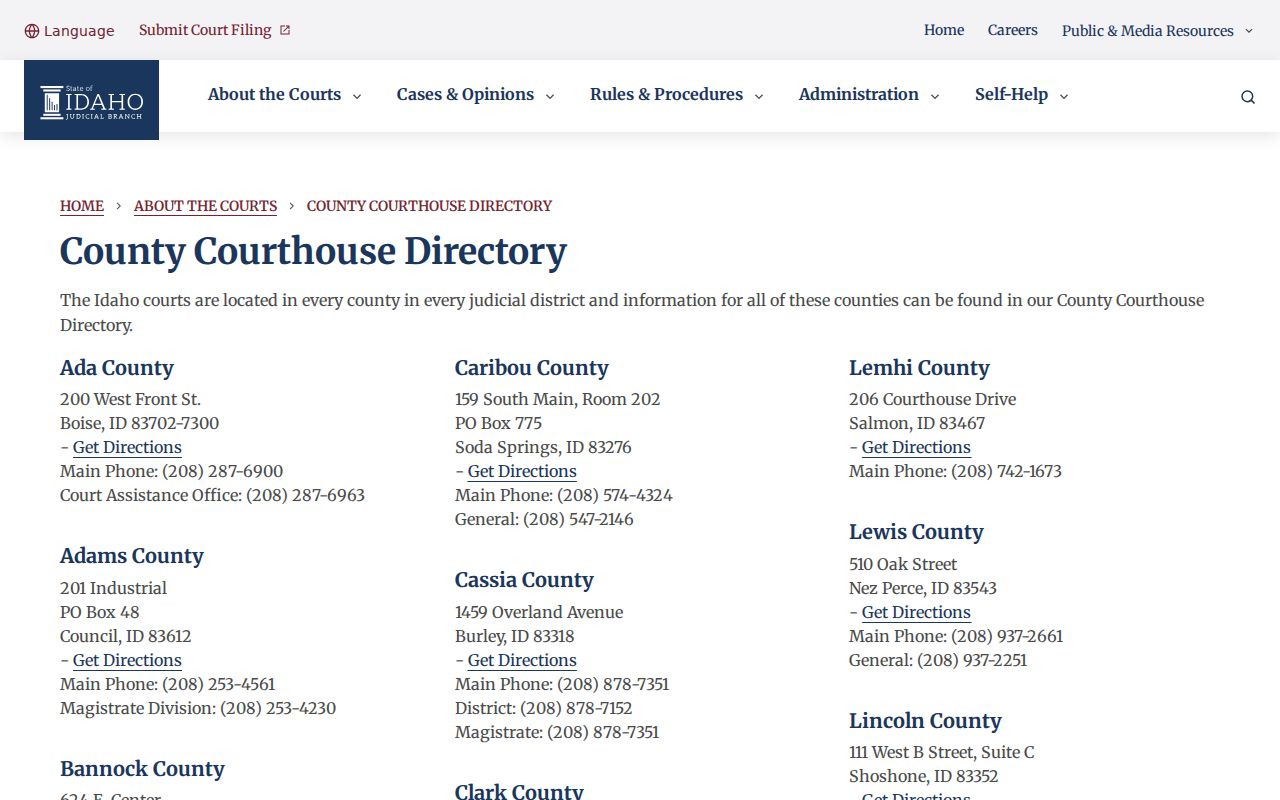
That directory anchors an online result to the clerk who can confirm the docket and provide the record.
Searching Clearwater County Case Records
Begin broadly enough to catch spelling variations, then narrow the result using court and case details. A docket entry is an index to activity, not a substitute for reading the order it describes.
- Open iCourt and choose public case search.
- Enter the party’s last and first name, or use the complete case number when known.
- Limit results to Clearwater County and the relevant criminal category or filing period.
- Open the likely docket and compare charges, dates, status, and court location.
- Request the needed pleading, judgment, or certified copy from the Clearwater clerk if it is not remotely available.
| Search field | Use | Matching caution |
|---|---|---|
| Party name | Find candidate cases | Try spelling variants and verify identity |
| Case number | Reach one file directly | Retain its complete format |
| County/location | Limit to Clearwater | A person may have cases elsewhere |
| Case category | Focus on criminal matters | Felony preliminaries may begin in magistrate |
| Filing/event date | Separate similar results | Event date is not necessarily arrest date |
The Orofino Courthouse Record Counter
For a particular case document, Idaho Courts directs the requester to a computer kiosk in an Idaho county courthouse or to the clerk where the case was filed. Clearwater’s counter is at 150 Michigan Avenue, Room 201, P.O. Box 586, Orofino, Idaho 83544. The Judicial Branch lists 208-476-5615; county material also publishes 208-476-5596 for the court line. Call first to confirm which number fits the request, current hours, copy cost, certification charge, and delivery method.
Clearwater County Court Clerk
150 Michigan Avenue, Room 201
P.O. Box 586
Orofino, ID 83544
General court: 208-476-5615
County-published court line: 208-476-5596
The official Idaho court-record access explanation distinguishes remote basic information, courthouse kiosk access, and clerk requests.
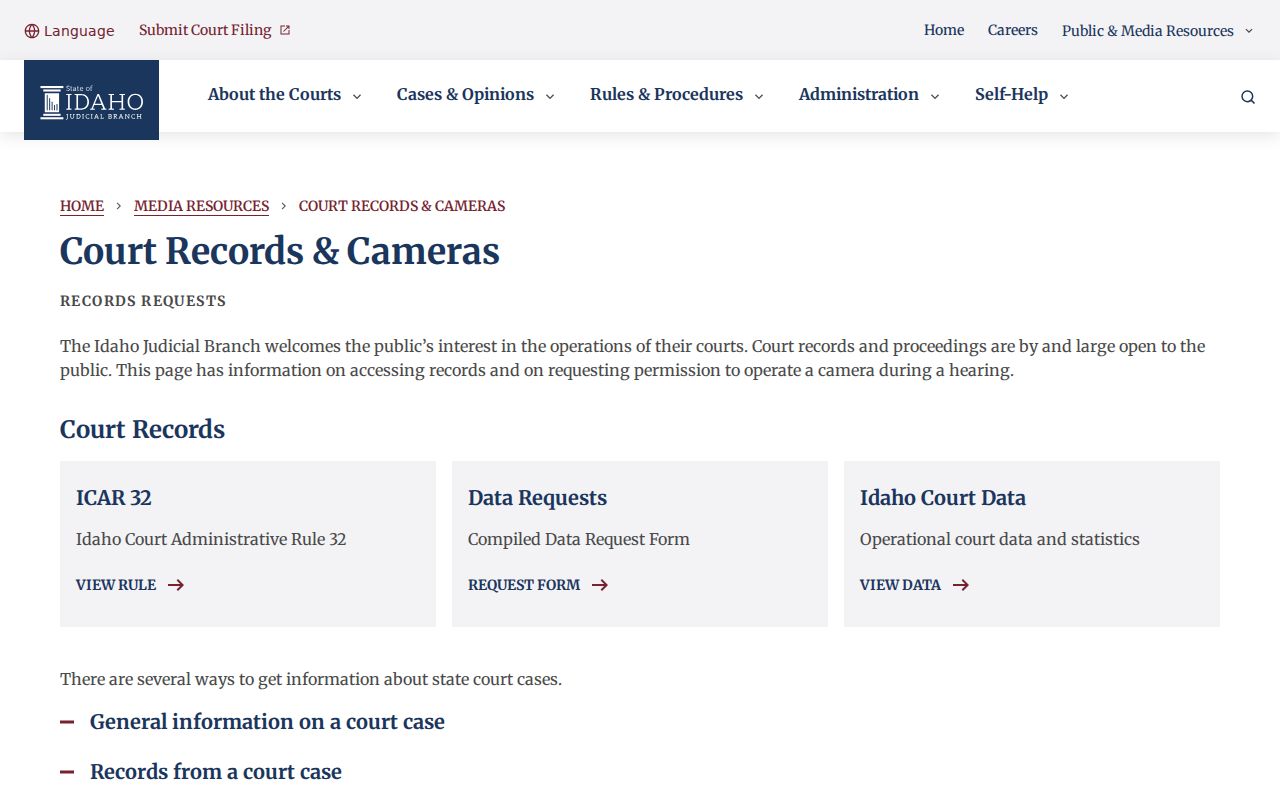
That three-channel model matters when the online docket omits the document a reader needs.
Inside a Clearwater County Case File
A file documents the prosecution as filed, not simply the allegations written at booking. Charges can be amended or declined after prosecutor review. Read each count separately and look for its own outcome.
| Case number and court | Identifies the Clearwater division, file, and court location. |
|---|---|
| Charging document | Complaint, information, or indictment stating the filed counts and statutes. |
| Docket entries | Chronological index of filings, hearings, orders, warrants, and later activity. |
| Hearing dates | Scheduled and completed proceedings; a setting alone does not reveal an outcome. |
| Disposition and judgment | Pending, dismissed, acquitted, plea, verdict, or other count-level result. |
| Sentence and conditions | Custody, probation, fines, restitution, and other terms when public. |
Protected identifiers, victim or minor information, sealed material, and some addresses do not belong in the public view. A financial summary may appear, but the judgment and sentencing order are better sources for the legal result.
District and Magistrate Case Roles
The Idaho Judicial Branch’s district-court overview explains why one Clearwater prosecution can show activity associated with both magistrate and district functions.
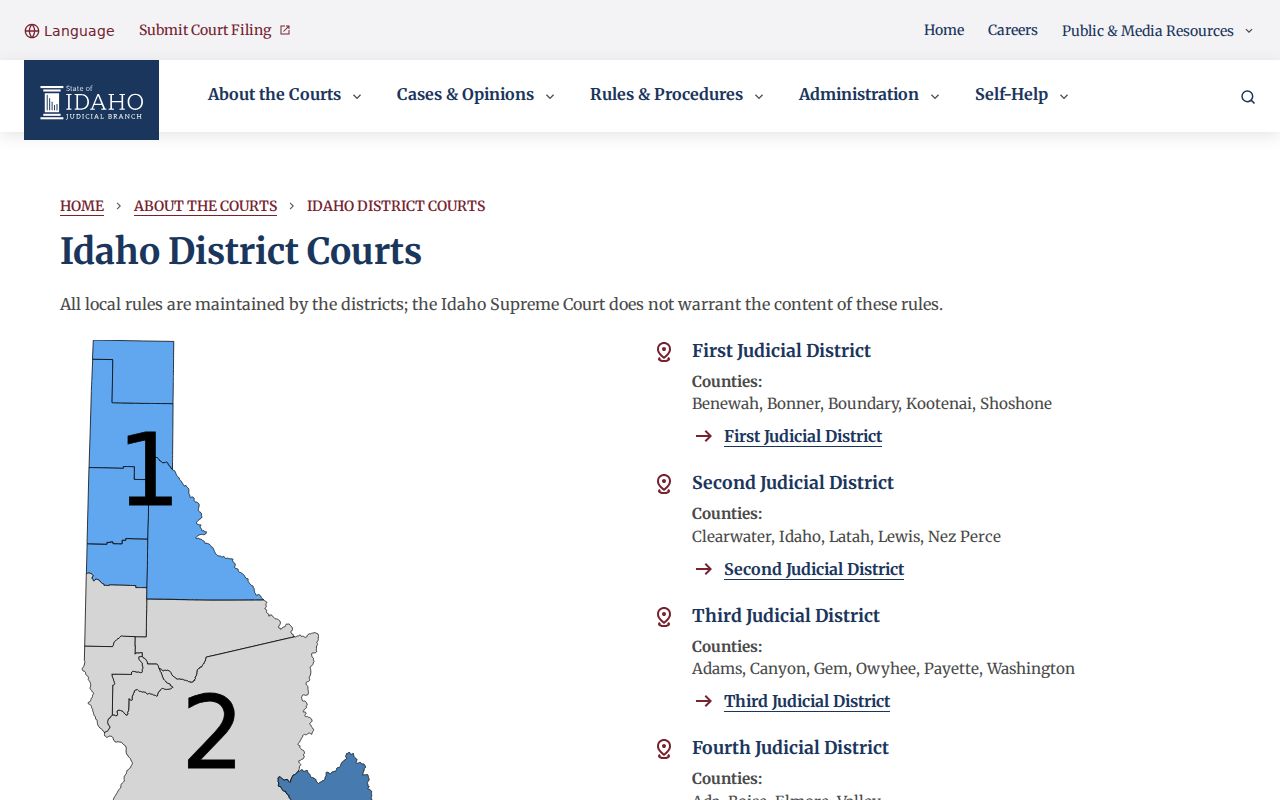
The image supplies statewide structure, while the Clearwater docket and clerk identify the local file.
For a felony, magistrate proceedings can address the first appearance and preliminary process before a district judge handles trial-level proceedings. Misdemeanors and infractions ordinarily remain within magistrate jurisdiction. The distinction explains why searching only for a “district” label can miss early events and why the full case number is the safest reference when requesting documents.
How a Criminal Case Moves
The filed case does not always preserve the booking charge word for word. After an arrest or summons, the prosecutor reviews the facts and selects the counts that enter court. The judge then addresses rights, release, scheduling, motions, and resolution. Each stage leaves different docket entries.
Case flow: Charges Filed › Arraignment › Pretrial › Plea or Trial › Disposition › Sentencing
A complaint starts the accusation; an information commonly states a felony charge after preliminary procedure; an arraignment states charges and takes a plea. “Dismissed” means a count ended without conviction, while “acquitted” reflects a not-guilty decision. Neither term should be read as though the original arrest never existed in agency records.
When Clearwater iCourt Omits a Document
First confirm that the result is in Clearwater County and that the name, case number, and filing year agree. Then note the exact docket entry, document title, and date. Ask the filing clerk whether the item is public and available through the courthouse kiosk, as an ordinary copy, or as a certified copy. Do not ask the Prosecuting Attorney to serve as the clerk’s copy counter.
If no case appears at all, possibilities include a spelling mismatch, a filing delay, charges not yet filed, a restricted case, or an event held by another county. A sheriff arrest report does not guarantee a court case was opened. Conversely, a summons can create a case without a local jail booking. For compiled statewide court data rather than one case, Idaho Courts directs requests to the Administrative Office of the Courts.
Case Record Access and Restrictions
Idaho Court Administrative Rule 32 recognizes access to records from proceedings open to the public and identifies exempt or restricted judicial records.
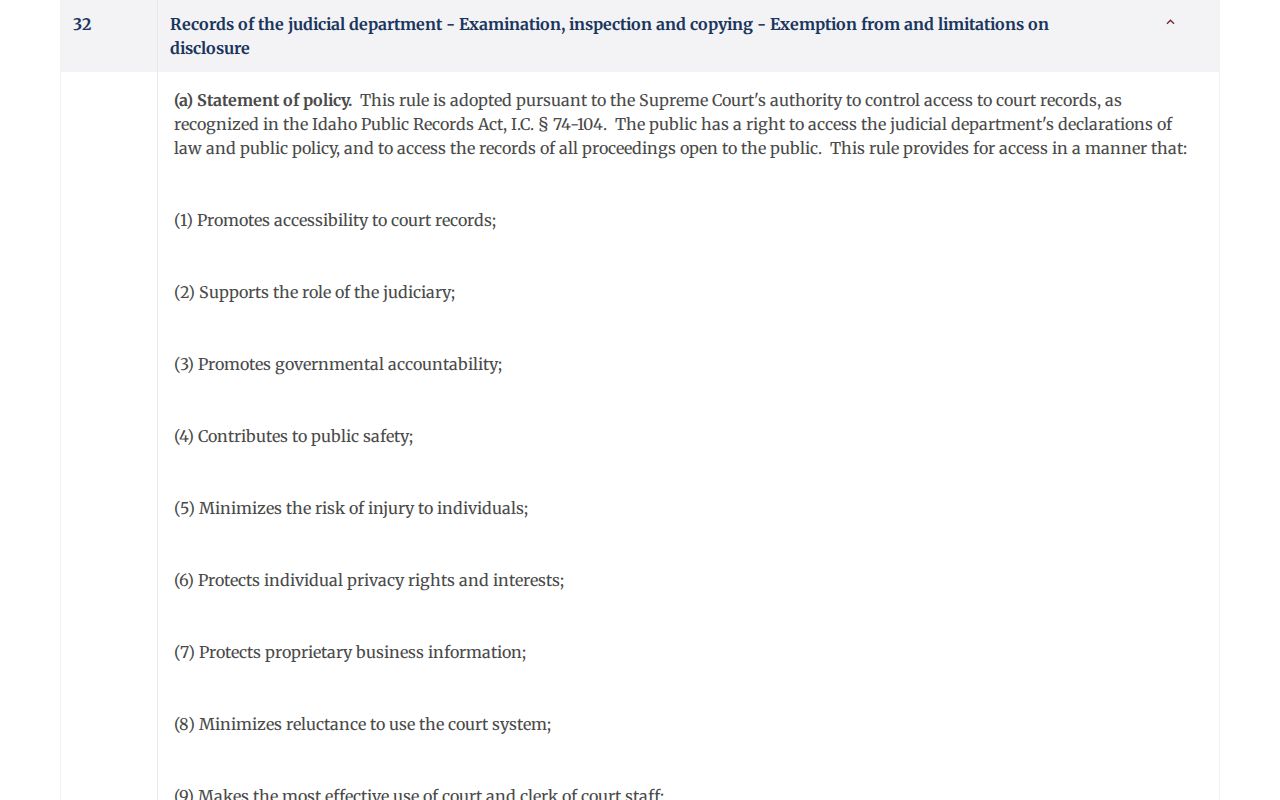
The rule explains why a public docket can coexist with redacted or unavailable documents.
Juvenile matters, sealed files, protected addresses, victim and minor information, Social Security numbers, account data, and some investigative material may be restricted or redacted. If a public case is missing, ask the clerk whether the search is incomplete or access is legally limited; do not treat the absence as proof that the event did not happen.
Disposition, Shielding, and Record Survival
A dismissal or acquittal is a vital court outcome, but it does not automatically destroy a fingerprint-supported BCI arrest cycle. Idaho Code §67-3004(10) allows a narrow written expungement request for eligible events, including certain cases in which no indictment or information was filed within one year, all charges were dismissed, or the person was acquitted of all offenses arising from the event.
Clean Slate shielding under §67-3004(11) is different from destruction. Official instructions describe offense limits, completion of the full sentence, a five-year waiting period, and a one-petition lifetime limit. A person considering relief should retrieve the Clearwater case number, exact statutes, disposition, sentence-completion dates, and financial-obligation status before using the Idaho court forms. After an order, check both public iCourt visibility and a personal BCI record for consistency.